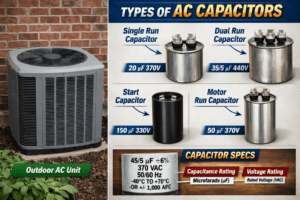
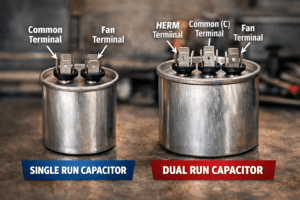
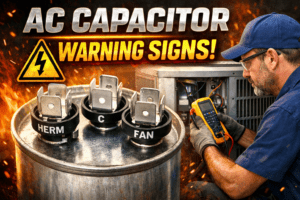
One of the most overlooked factors when replacing an HVAC capacitor is matching it to your system’s tonnage. Using a capacitor that’s too small stresses the motor; too large and you risk overheating.
How tonnage maps to capacitor size:
| System Size |
Typical Capacitor Rating |
| 1.5 – 2 ton |
25+5 µF / 370–440 VAC |
| 2.5 – 3 ton |
35+5 µF / 440 VAC |
| 3.5 – 4 ton |
40+5 µF / 440 VAC |
| 4 – 5 ton |
45+5 µF / 440 VAC |
Why tolerance matters: A ±3% tolerance rating means the capacitor’s actual capacitance stays within 3% of its labeled value across its full operating temperature range. Mismatched voltage ratings are a leading cause of premature failure, and putting in a capacitor with the wrong µF value — like a 35/5 µF 370V unit instead of a proper 45/5 µF 440V dual — can seriously stress the compressor motor. Sacohelectronic
Why 105°C rating matters for rooftop units: Rooftop HVAC systems face extreme heat exposure. A capacitor rated for continuous operation at 105°C handles summer ambient temperatures and radiant heat without degrading, while a standard 85°C-rated unit may fail prematurely in the same environment.
The rule of thumb: Always match or exceed the original voltage (VAC), match the µF values exactly within ±5–10%, and choose a 105°C-rated, ±3% tolerance unit for any rooftop or high-heat installation. It costs a little more upfront and saves a compressor replacement down the road.